

Key Takeaways:
- Continuous background checks catch risks in real time, giving you stronger compliance and closing the visibility gaps that periodic rescreening leaves wide open.
- First-party, privacy-by-design screening puts candidates in control, cuts down on unnecessary data exposure, and makes compliance simpler for employers.
- Automated, alert-driven workflows let your team focus on the risks that actually matter. You can enroll your entire workforce without a complicated IT overhaul.
Picture this: a financial services firm runs its annual rescreening, and everything looks clean. But four months later, one of their employees has their license suspended. For eight months, that person keeps handling regulated transactions. Nobody knew.
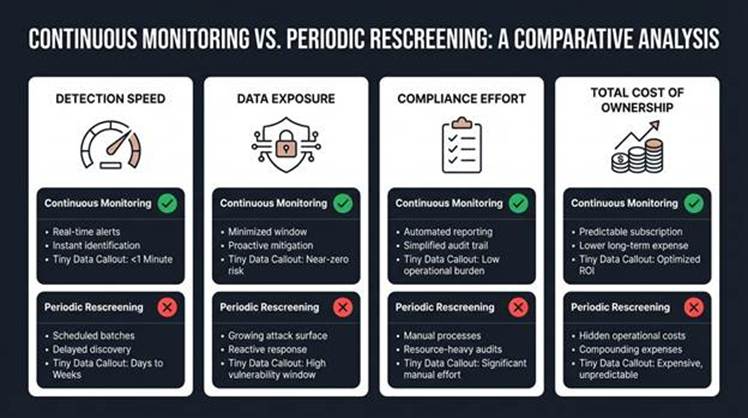
That is the blind spot periodic rescreening creates. And it raises a question every compliance team needs to answer: how do continuous background checks compare to periodic rescreening when it comes to actually protecting your organization?
Recent CFPB guidance makes it clear that continuous monitoring has to follow Fair Credit Reporting Act (FCRA) requirements. EEOC standards stress the importance of consistent, job-related screening policies. Solutions like Trua-CE™ tackle these requirements with first-party, privacy-first monitoring. You get real-time alerts without storing personally identifiable information in your HR systems. Instead of risk windows, you get continuous confidence.
Compliance, Privacy, and Legal: How Do Continuous Background Checks Compare to Periodic Rescreening?
When you shift from periodic snapshots to ongoing monitoring, new compliance questions come up. Here are the big ones, along with clear answers.
How does a first-party FCRA model change employer obligations?
With first-party screening, the FCRA compliance burden shifts from the employer to the employee. Candidates run their own background checks and share the verified results directly with HR. That means you skip the complex adverse action procedures. It reduces legal liability. And it streamlines your compliance work, because you are receiving pre-authorized results through the first-party verification process instead of launching third-party investigations.
What due process steps does continuous monitoring require?
You need upfront disclosure and authorization, just like any screening program. The difference is you do it once. Employees give their permission, and from there, they and you get notified immediately if anything gets flagged. The privacy-first screening approach only surfaces material alerts. That cuts down on admin work while keeping things transparent for employees.
How does privacy-by-design screening reduce PII exposure?
Traditional rescreening stores full background reports in your HR systems. That is a data liability sitting in your files. 1st party continuous monitoring flips this: all personally identifiable information stays in encrypted databases for the individual, never on your company’s systems. You only see verified results through a secure portal. Trua-CE™ surfaces only flagged changes, so you are not holding onto data you do not need.
Does continuous monitoring meet financial services regulatory expectations?
Yes. SEC and FINRA expect timely identification of material changes like license suspensions, criminal charges, or regulatory violations. Continuous monitoring delivers that in a few weeks, not months. With annual or quarterly rescreening, you are looking at risk windows of 3 months to 12 months. That is nearly a year where a compliance violation could go completely undetected.
How do candidates review and dispute findings with ongoing monitoring?
Candidates can access their background information anytime. If there is an inaccuracy, they can address it before sharing results with an employer. They do not have to wait for the next rescreening cycle. This proactive setup reduces false positives, protects candidate rights, and prevents unnecessary adverse employment actions based on outdated info.
Risk Mitigation and Real-Time Alerts: What Changes Day to Day?
Moving from periodic snapshots to continuous visibility changes how your team handles risk. Here is what that looks like in practice.
What risks do annual or quarterly rescreens miss that continuous monitoring catches?
License suspensions, professional sanctions, criminal charges. These things happen between scheduled rescreens all the time. A financial advisor could lose their securities license in March, but your annual check would not catch it until the following year. Continuous monitoring flags it it sooner.
How do real-time alerts help teams focus on what matters?
Instead of reviewing hundreds of unchanged employee files, your compliance team only gets notified when something actually happens: a court filing, a license suspension, a sanction. No more wading through stacks of “no change” reports every quarter or year.
Can alert criteria be tailored by role or department?
Absolutely. You can set different thresholds based on role sensitivity and regulatory requirements. Executive-level positions might trigger an alert for any civil litigation, while general employees only get flagged for criminal charges. This keeps your team from drowning in alerts while still maintaining the right level of oversight for each role.
How does continuous monitoring reduce insider-threat windows?
Fixed rescreening intervals create long vulnerability gaps. Think about it: an employee facing financial pressure might commit fraud 10 weeks into a 52-week rescreening cycle. That leaves 42 weeks where nobody knows. Continuous monitoring shrinks those windows to a few weeks.
What data sources make continuous monitoring effective?
Trua-CE™ monitors over 25,000 public data sources: court records, professional license databases, civil filings, educational credentials, certification bodies, and more. This kind of comprehensive coverage catches things that single-source checks miss, giving you earlier warning signals for potential threats or compliance violations.
Operations, Cost, and Implementation: From Pilot to Enterprise Scale
Switching from periodic rescreening to continuous monitoring is a big operational shift. Here is what you need to know about deployment, scaling, and cost.
What is the operational difference between quarterly rescreens and continuous monitoring?
Batch rescreening creates those painful workload spikes where your team processes hundreds or thousands of reports at once. Continuous monitoring turns that into a steady, exception-based workflow. You only review what gets flagged. A global airline processed 11,000 monitoring events over 120 days, with teams focusing solely on 1,771 critical alerts instead of reviewing every single file.
How does plug-and-play deployment compare to legacy integration?
Traditional rescreening vendors usually require API integrations, data mapping, and ongoing IT support to connect with your HRIS or ATS. Plug-and-play continuous monitoring skips all of that. Alerts flow through secure portals without touching your core systems. Deployment goes from months to weeks, and sensitive employee data stays off your infrastructure entirely.
How does the total cost of ownership change?
The cost structure shifts from high-volume batch processing to targeted, event-driven reviews. You stop paying for full-file reruns on employees with no changes. You cut manual review hours through automated flagging. A national auto financing firm found that continuous monitoring bridged coverage gaps that periodic rescreening missed, saving them from expensive remediation down the road.
Can you enroll existing employees without disrupting operations?
Yes. Continuous monitoring lets you retroactively enroll your entire workforce, including employees hired years ago. The enrollment process runs independently of your hiring workflows, so there is no disruption. This solves a big limitation of periodic rescreening: few employers have adopted rolling checks because the operational complexity has been too high.
How does privacy-by-design reduce your data exposure?
Instead of storing complete background reports in HR systems, privacy-first solutions like Trua-CE™ surface only flagged changes that need attention. This minimizes the PII your organization handles while keeping comprehensive oversight intact. Workplace privacy regulations increasingly favor systems that collect minimal data, which means less compliance burden and less potential liability for you.
Governance, Auditability, and Change Management for Compliance Stakeholders
Continuous monitoring makes governance more complex in some ways, but it also gives you stronger proof of oversight. Here is how to handle it.
What audit trails does continuous monitoring produce?
Continuous monitoring platforms generate detailed audit logs: consent records, alert triggers, review decisions, escalation paths. Trua-CE™ maintains ISO 27001-certified documentation of all monitoring activities and data sources. When regulators come knocking, you are showing them a proactive approach to risk management, not just a collection of periodic snapshots.
How do you configure alert thresholds and escalation paths?
You can customize what triggers an alert based on the department, the sensitivity of the role, and what regulators expect. So someone in an executive position might get flagged for any civil litigation, while a general employee would only trigger a notification for criminal charges. From there, alerts get routed to the right reviewer based on how severe the issue is and where it falls in your org chart. The whole point is a proportional response, not a flood of notifications nobody has time to read.
How do you balance transparency with employee privacy?
First-party screening models give employees control over their data and results before anything gets shared with an employer. CFPB guidance requires clear disclosure of continuous monitoring practices. Employees can review their reports, fix inaccuracies, and decide whether to share results with any employer.
What training helps teams adopt continuous monitoring without surveillance concerns?
Good change management is essential here. Training should emphasize how continuous oversight protects both the organization and the workforce. Clear communication about data minimization, exception-based alerts, and employee control helps teams see the privacy-protective design for what it is, rather than viewing it as Big Brother.
How do reusable credentials streamline multi-entity collaboration?
TruaID™ and TruaScore® let employees share verified credentials across multiple organizations without exposing raw background data. TruaBroker™ facilitates secure sharing while keeping personally identifiable information in blockchain-encrypted storage rather than on employer systems. Less data liability, smoother collaboration between business partners and subsidiaries.
Move From Snapshots to Continuous Confidence
Periodic rescreening leaves dangerous gaps between checks. Continuous background checks with real-time compliance monitoring close those gaps while strengthening your FCRA obligations through first-party verification. And with privacy-first screening, candidates stay in control of their own data.
Trua-CE™ delivers automated, alert-driven workflows that scale across your entire workforce, no IT integration required. You can enroll existing employees for ongoing protection while cutting the total cost of ownership. Real-time alerts keep your team focused on actionable risks instead of routine batch processing.
Ready to stop relying on periodic snapshots? Request a demo to see how role-based alerts and privacy-first screening can transform how you manage risk.