


Key Takeaways:
- Adopt continuous, candidate-controlled background checks to accelerate hiring, reduce bias, and maintain compliance with evolving privacy and anti-discrimination regulations.
- Minimize organizational risk and liability by leveraging privacy-first technologies that keep personally identifiable information out of HR systems and empower candidates to control their own data.
- Implement structured, auditable adjudication practices and regular outcome audits to ensure fair, inclusive, and legally defensible hiring decisions.
Traditional employment background check processes can take weeks to complete and often introduce unintended bias into hiring decisions. Meanwhile, point-in-time screening leaves organizations blind to post-hire risks that develop between periodic checks.
An inclusive employment background check program must be continuous, compliant, and transparent. It should protect personally identifiable information (PII) while minimizing bias and enabling faster hiring without sacrificing safety.
This guide outlines a privacy-first workflow, de-biasing tactics, and modern technology that enables candidate-controlled verification and continuous monitoring. Trua empowers organizations to build these next-generation screening programs with 70% faster onboarding and full compliance.
Build a Privacy-First, Compliant Employment Background Check Workflow
You know the frustration: candidates drop out during lengthy background check processes, compliance requirements keep shifting, and your HRIS holds more sensitive data than you’re comfortable managing.
The most recent CFPB guidance on privacy and compliance in employment background checks clarifies that many third-party screening practices fall under Fair Credit Reporting Act oversight, making candidate-driven alternatives more attractive than ever.
Enable First-Party, Candidate-Driven Verification
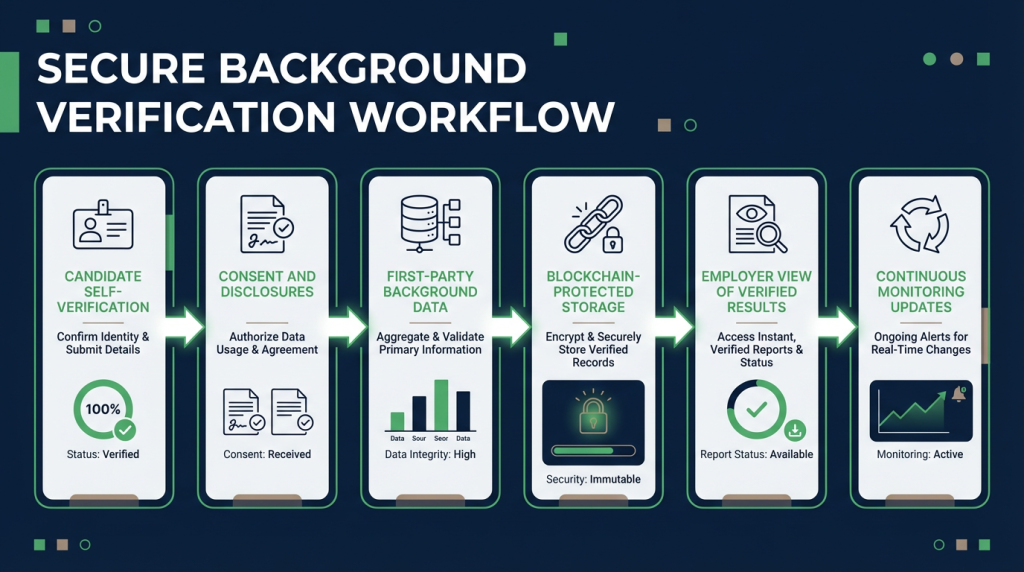
First-party screening flips the traditional model by having candidates conduct their own background checks and share results directly with employers – all the results the employer specifically requires, not just what the candidate wants to show . This approach aligns with FCRA requirements while giving candidates transparency and control over their own PII data from the start.
Candidates can review their results, address any inaccuracies, and choose whether to proceed with sharing. This transparency reduces disputes and builds trust while keeping your organization compliant with evolving regulations.
Minimize PII Storage and Liability Exposure
This first-party candidate-controlled approach also enables your business to avoid storing raw PII entirely. Forward-thinking organizations access verified screening results through secure portals that provide decision-making data without the liability of housing sensitive personal records.
EEOC guidance emphasizes secure disposal obligations and recordkeeping requirements that become much simpler when you never store the underlying PII data. Trua’s privacy-first design protects both your organization and your candidates by keeping PII in blockchain-encrypted databases – the Trua vault – rather than your systems.
Implement Continuous Monitoring for Real-Time Risk Management
Moving beyond point-in-time checks, continuous monitoring surfaces material changes, often within 48 hours, giving your business real-time visibility into its workforce risk. This approach eliminates significant risk gaps between hire date and annual reviews.
When candidates maintain their own verified PII profiles through solutions like TruaScore®, they can share updated, reusable credentials across roles and subsidiaries. This eliminates redundant screening delays while maintaining the highest standards for ongoing risk management.
Reduce Bias in Employment Background Checks With Structured, Auditable Practices
Bias in background screening often stems from inconsistent decision-making, and the EEOC guidance provides a clear framework for fair adjudication, while research shows that incarceration history can trigger unconscious bias in hiring decisions.
The key is empowering both employers and candidates through structured, transparent processes that technology can help standardize and audit:
- Create role-specific adjudication matrices that define which offenses are job-related based on the nature, gravity, and time elapsed since the conviction, tailored to your specific positions and jurisdictions.
- Document your decision criteria with clear scoring rubrics that separate recent, severe, job-related offenses from minor or outdated records, making your rationale explainable and defensible.
- Conduct individualized assessments for any adverse decisions, considering rehabilitation evidence, character references, and the specific circumstances of each case as required by EEOC standards.
- Enable candidate review and dispute processes before final decisions, allowing people to correct errors, provide context, or address inaccuracies that disproportionately affect underrepresented groups.
- Audit your outcomes regularly by tracking approval rates across demographic groups and adjusting your criteria when patterns suggest disparate impact on protected classes.
Upgrade From One-and-Done to Continuous, Candidate-Controlled Screening
Structured practices lay the foundation, but technology can help transform how your business to manage ongoing workforce risk. Modern, continuous background checks close these gaps while putting candidates in control of their own data.
- Real-time monitoring detects important changes, as fast as 48 hours, eliminating months-long exposure between periodic reviews.
- Secure, encrypted profiles store PII outside your HRIS, minimizing data liability while enabling rapid verification across roles.
- Candidate preview and control allows people to review results before sharing, building trust and preventing disputes.
- Reusable credentials eliminate redundant screening delays when employees move between departments or subsidiaries.
- Automated compliance tracking maintains FCRA obligations while streamlining ongoing authorization and disclosure requirements.
This shift from reactive to proactive screening addresses the modern hiring risks that one-time checks simply cannot catch.
Continuous monitoring paired with candidate transparency creates a foundation for both security and trust with your business and its staff.
Employment Background Check FAQs for Inclusive, Fast, and Compliant Hiring
HR leaders face complex questions about building screening programs that deliver speed, while maintaining compliance and advance inclusion. These answers provide actionable guidance for protecting candidate privacy while accelerating confident and trust in bias-free hiring decisions.
How can employers ensure privacy and compliance during employment background checks?
Store no personally identifiable information (PII) in your HRIS systems. Use first-party verification where candidates control their data sharing. Follow FCRA requirements for proper disclosures, written consent, and adverse action procedures. Choose secure platforms that encrypt candidate data to minimize exposure while maintaining audit trails. TruaScore® offer such a platform for businesses of all sizes.
What steps can organizations take to minimize bias in employment background screening?
Develop standardized adjudication matrices that focus on job-related, recent offenses. Conduct individualized assessments as required by EEOC guidance. Allow candidates to review and dispute screening results before decisions. Document your reasoning consistently across global jurisdictions and all applicants to demonstrate fair treatment.
What are the latest technologies transforming the employment background check process?
Continuous monitoring is now replacing the one-time-check legacy IDV and background screening solutions, that are found in today’s marketplace. Advanced encryption protects candidate this continuous screening data, while enabling secure sharing. AI-driven scoring systems, such as used in TruaScore® has transformed complex records from continuous screening into objective trust scores. Coupled with biometric identity verification, the combination prevents credential fraud while maintaining ongoing privacy.
How do continuous background checks reduce risk and improve onboarding speed?
Continuous screening surfaces material changes within 48 hours, eliminating gaps between annual reviews. Pre-verified candidate profiles accelerate approvals, reducing timelines from weeks to days. Ongoing monitoring reduces post-hire risk while streamlining compliance workflows. Organizations gain continuous workforce insights without repeated screening delays.
Can candidates control what employers see in their background reports?
Modern platforms enable candidate transparency and control. People can review their complete background profile, address inaccuracies, and share only the specific information required by the employers. This approach builds trust, reduces drop-off rates, and aligns with privacy-first hiring practices that benefit both candidates and organizations.
Operationalize Inclusive, Privacy-First Screening With TruaScore®
Modern inclusive background screening demands a fundamental evolution from traditional one-and-done checks to continuous, candidate-controlled verification. Organizations that embrace first-party assessment with blockchain-protected personally identifiable information can accelerate hiring by 70% while reducing bias and maintaining full FCRA compliance.
This transformation is powered by TruaScore®, which delivers a shareable trust score that puts candidates in control of their data while providing employers with ongoing monitoring of workforce risk. The platform stores no unnecessary PII in HR systems, enabling faster decisions without compromising security or candidate rights. This approach creates never-expiring verified credentials that benefit both employers and job seekers.
Build a fairer, faster hiring process that respects candidate privacy while meeting your compliance needs. Discover how Trua can revolutionize your screening approach today.