

Most HR teams still evaluate background screening vendors by turnaround time and price. In 2026, a model that goes dark after hire creates real risk. The real question is whether your screening reduces bias, protects candidate data, and stays useful after day one.
That shift is especially relevant when comparing the Top 5 IDV Background Screening companies Checkr, First Advantage, Sterling, HireRight and Trua.
The evaluation now spans identity verification, Fair Credit Reporting Act (FCRA) compliance, continuous monitoring, and unnecessary data exposure.
Where Checkr, First Advantage, Sterling and HireRight give the background screening reports to the company’s HR team. TruaScore® gives candidates this information through a portable trust credential they review, verify, and then securely share with the employer, drastically reducing compliance burden, onboarding time, and wrongful claims. Trua approaches background screening differently and should matches your 2026 priorities.
Senior HR leader and compliance colleague reviewing digital hiring workflows on a large screen and tablet in a modern conference room, conveying collaborative decision-making about trust, privacy, and faster onboarding.
Trua, Checkr, First Advantage, Sterling, and HireRight: Which Platform Best Fits Modern HR Priorities?
The differences between these platforms become clearest when you focus on how each handles data ownership and post-hire visibility.
A few operational questions cut through the noise:
- Who controls the candidate’s data?
- How does each platform balance speed, privacy, and compliance?
- How much IT lift does deployment require?
The breakdown below maps each provider across these dimensions, including whether the platform supports verifiable credentials (portable, tamper-evident digital records that candidates control and share selectively) that candidates can carry across job applications and internal role changes.
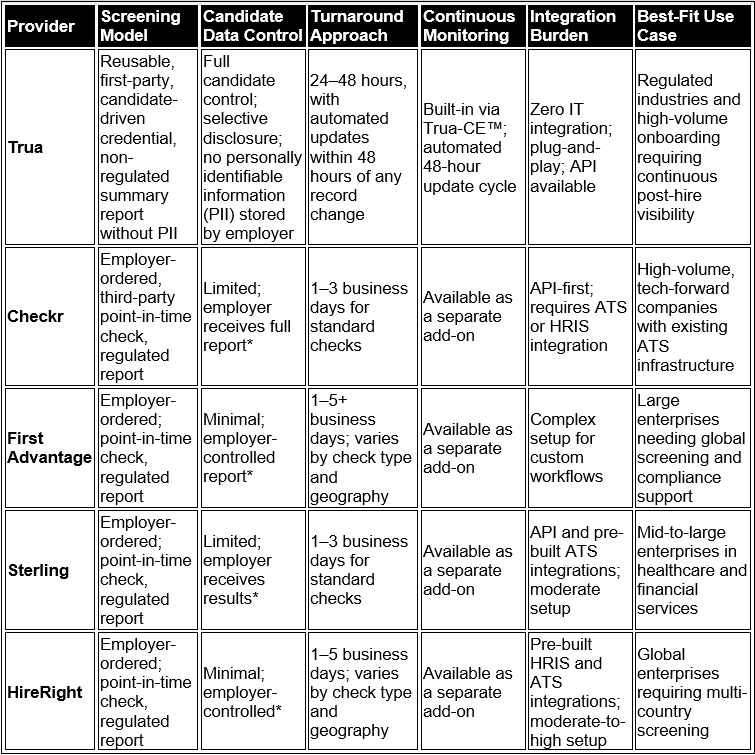
* All employer-ordered providers are subject to FCRA (Fair Credit Reporting Act) consumer dispute rights post-delivery
The CFPB’s 2024 circular on employment screening scores reinforces why the screening model column matters most. Platforms that collect and store candidate records on the employer’s behalf carry FCRA obligations that TruaScore® credentials are built to avoid, and Trua-CE™ provides the continuous monitoring layer that keeps risk visibility active well after day one.
How that continuous model shapes candidate experience and reusable trust credentials is where the next distinction becomes clear.
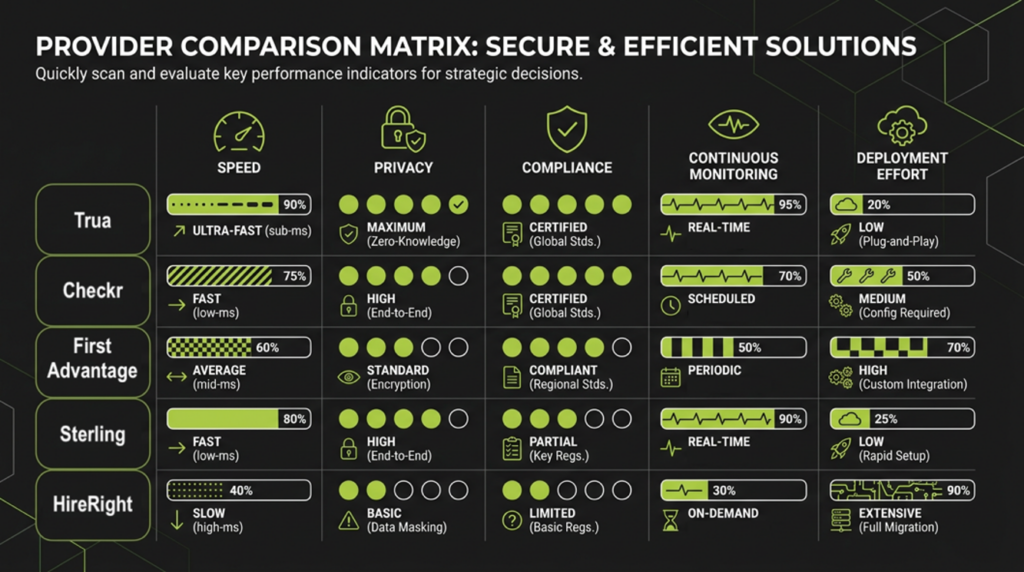
Why Candidate Experience and Reusable Trust Credentials Matter More Than Ever
SHRM’s candidate experience research shows that slow, opaque hiring processes directly hurt acceptance rates and damage your talent pipeline before an offer is even extended, and the impact falls hardest on the diverse candidates you’ve worked hardest to attract.
The right platform changes that equation, replacing repeated requests and opaque processes with a model where candidates move faster, share only what’s needed, and stay in control of their own data.
- Repeated screening requests frustrate candidates and stall hiring pipelines when speed matters most.
- When screening prioritizes speed over accuracy, candidates face errors they cannot see or dispute before a decision is made.
- TruaScore® lets candidates share a portable trust score across multiple roles without repeating the full screening process each time.
- Platforms that give people control over what they share align better with equitable hiring than employer-only access models.
- Continuous monitoring keeps workforce risk visible after day one, not just at the moment of hire.
For HR teams comparing identity verification and background screening platforms in 2026, the ones that win candidate trust are built around reusable trust credentials that candidates can review, control, and reuse across every role, partner, and opportunity ahead.
How Trua’s Continuous, Privacy-First Screening Model Differs From Traditional Background Checks
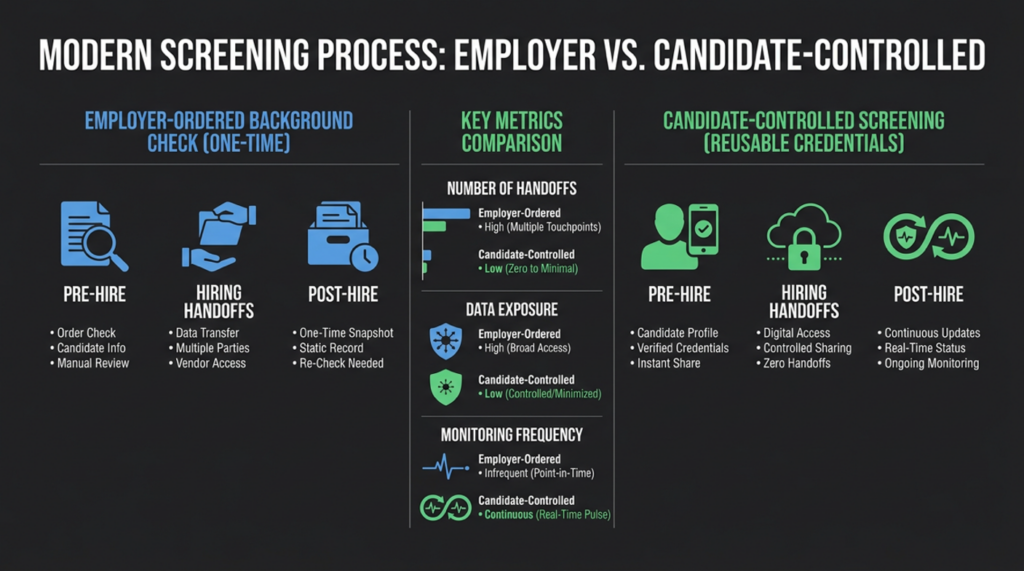
A candidate clears their background check on day one. Eighteen months later, something changes, and under most screening models, no one in HR would ever know. That gap is exactly what Trua’s continuous, privacy-first model is built to close, unlike the point-in-time reports delivered by most traditional providers.
The Snapshot Problem With Traditional Checks
A standard background check is a point-in-time record. It tells you who someone was at the moment of hire, not who they are today. According to SHRM, only 11% of employers rescreened workers as of the last major industry survey. Most organizations carry post-hire risk they simply cannot see.
First-Party, Continuous, and Blockchain-Protected
TruaID™ and shareable TruaScore® are built around candidate ownership, not employer retrieval. Candidates verify their own identity and background, then share results directly with employers. Trua-CE™ monitors continuously and pushes score updates within 48 hours of any change to criminal, civil, or public records. All PII stays in Trua’s blockchain-encrypted database. Your HR systems never touch it. That storage distinction is not just a technical detail. It carries real regulatory weight.
The Real Privacy Question: Who Holds the Data?
When employers order traditional background reports, they take on data handling obligations under the Fair Credit Reporting Act (FCRA). The CFPB’s 2024 circular confirms that third-party background dossiers and algorithmic scores are subject to FCRA when used in hiring decisions. In practice, that means disclosure requirements, written authorizations, and pre-adverse action notices before any hiring decision can move forward. The FTC outlines each of those obligations in detail. When candidates own and share their own verified credentials, employers receive the result without inheriting the liability.
FAQ: What Should HR, Compliance, and Security Leaders Ask Before Choosing a Screening Partner?
When the stakes include regulatory fines, wrongful hire claims, and candidate trust, vendor selection deserves more scrutiny than a feature checklist. Compliance, HR, and security leaders comparing the leading five IDV and background screening companies for high-assurance onboarding need answers that go deeper.
Data ownership, compliance obligations, and risk management throughout the employment lifecycle are where the real differences emerge.
What Is the Difference Between First-Party and Third-Party Screening Under the FCRA?
When a candidate verifies and shares their own report, that is first-party screening, with no FCRA third-party obligations for the employer. When an employer orders from a Consumer Reporting Agency (CRA), the full set of FCRA obligations applies. That includes candidate notification, adverse action steps, and dispute resolution rights. This approach is subjected to strict compliance process, potential litigation due to wrongful claims, etc.
How Much Candidate Data Does My Organization Actually Need to Store?
Less than you might think. Platforms that keep personally identifiable information (PII) in their own infrastructure reduce your data handling liability considerably. TruaScore® is one example of a model where raw records never enter your enterprise until after the candidate is fully onboarded for payroll and other benefits purposes.
What Level of Continuous Post-Hire Monitoring Do I Actually Need?
Start by asking whether the platform can be configured by role type, not applied uniformly across your workforce. Finance and healthcare roles often carry compliance obligations, such as FINRA requirements, that mandate ongoing monitoring. The EEOC guidance on employment decisions also supports individualized assessment, meaning monitoring thresholds should reflect actual job requirements. Insider Threat is the most significant risk that employers are facing this connected enterprise ecosystem ( contractors, supply-chain vendors, partners, etc.)
How Should I Evaluate a Vendor’s Dispute Process Before Signing a Contract?
Vendors have a legal obligation to forward candidate-submitted evidence during dispute investigations, as established by CFPB Circular 2022-07. Vendors who restrict how candidates submit evidence or fail to pass it along create real legal risk for your organization. Ask any prospective partner to demonstrate their dispute workflow in detail.
What Identity Assurance Standards Should I Require From a Screening Partner?
Ask vendors whether their identity proofing meets NIST SP 800-63 standards, which define how strongly they verify who someone actually is. Higher-assurance roles require stronger verification controls. Vendors who cannot show they meet recognized identity assurance standards introduce identity fraud risk and invite regulatory scrutiny.
A vendor who answers these questions with specifics, not generalities, is worth a serious look when making the 2026 buying decision.
The 2026 Buying Decision: Choose the Platform That Lowers Friction, Exposure, and Risk
The screening platform you choose in 2026 needs to do more than check a box at hire. CFPB guidance, FTC guidance, and EEOC standards all confirm that how you score, store, and share applicant records can trigger federal compliance obligations.
For HR and recruiting teams, that means moving from one-time checks to ongoing screening to reduce compliance risk while closing post-hire blind spots. TruaScore®, backed by TruaID™ verification, delivers portable credentials that update within 48 hours, making it a proven HR recruiting and risk mitigation tool.
See how Trua helps your team move to privacy-safe credentials with continuous monitoring and 24 – 48 hour turnaround.