

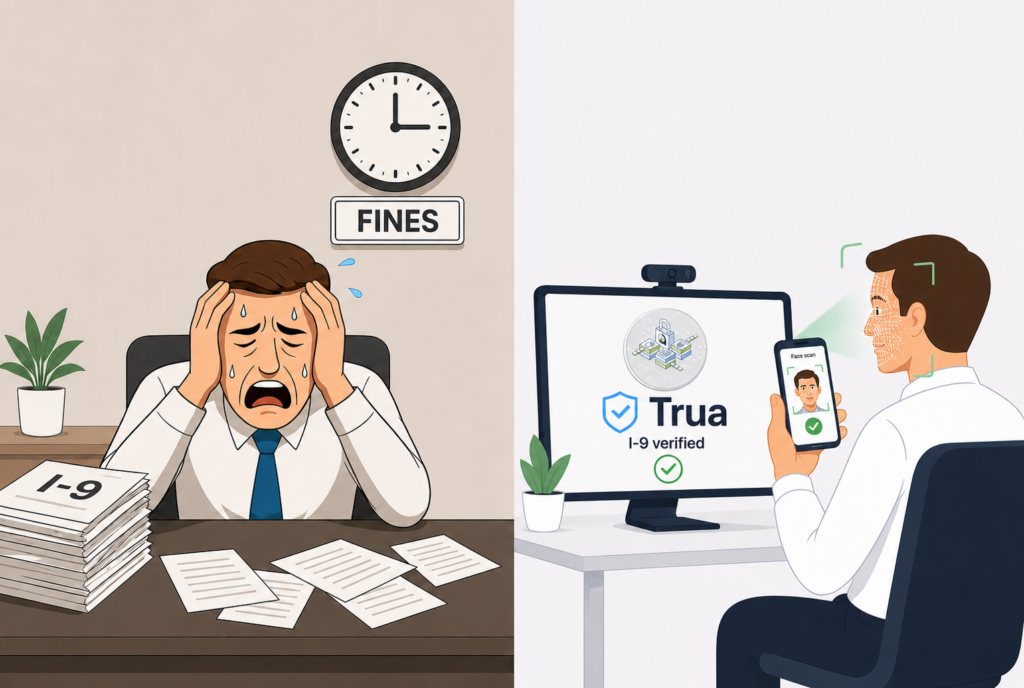
Millions in fines for paperwork mistakes? It’s happening right now. In 2025, U.S. Immigration and Customs Enforcement (ICE) delivered multiple wake-up calls to employers. In one major action, ICE proposed over $8 million in civil penalties against three Colorado janitorial companies following Form I-9 audits that uncovered widespread employment eligibility violations. CCS Denver, Inc. alone faced $6.2 million for issues involving at least 87 unauthorized workers.
Even larger employers aren’t immune. Walmart has been fighting a proposed $24 million civil penalty tied to audits of more than 20 facilities that identified over 11,000 Form I-9 recordkeeping violations. These cases highlight how routine paperwork failures and verification gaps can escalate into massive liability, especially as ICE ramps up audits and reclassifies more errors as substantive violations in 2026 and beyond.
What Form I-9 Actually Requires:
Employees (Section 1): Must complete and sign by the end of Day 1. They choose and present their own documents proving both identity and employment authorization. Employers cannot dictate or prefer any documents and employees have full choice and get to pick from the following:
- One from List A (establishes both identity & work authorization), e.g., U.S. Passport (or Passport Card), Green Card (Form I-551), or Employment Authorization Document (Form I-766).
- Or one from List B (identity only, e.g., Driver’s License, State ID, or U.S. Military ID) + one from List C (work authorization only, e.g., Social Security Card or U.S. Birth Certificate).
Employers (Section 2): Examine the documents within 3 business days, verify they reasonably appear genuine and belong to the employee, complete Section 2, and retain the form properly. Produce it within 3 business days if inspected. Run E-Verify if enrolled. Never pre-fill Section 1 or show document preference.
Where I-9 Compliance Breaks for Growing Businesses in 2026:
- Day 1 paperwork hunts create a stressful, poor first impression for new hires including ever increasing remote hiring and onboarding.
- Tiny errors now trigger immediate penalties under ICE’s updated guidance where many formerly “technical” mistakes are now substantive, with fines of $288 to $2,861 per form.
- The unforgiving 3-day clock, re-verifications, and multi-year retention compliance burden HR and operations teams.
- Remote/distributed workforces add complexity.
At Trua, we built a better way, enterprise-grade I-9 verification that puts compliance and people first.
- Faster onboarding for high-volume hiring: Workers complete secure verification in under 15 minutes on their phone. Employers finish Section 2 in minutes against already-verified evidence. New hires are fully live in under 30 minutes.
- Compliant by design: Equal document options to prevent discrimination. Employees always own their Section 1. Automatic handling of 3-day deadlines, retention, re-verifications, and E-Verify integration. Remote checks are fully legal and our default.
- Backed by Regulation: Trua is built directly on key DHS rules, including the 2023 Optional Alternative Procedure for remote document examination (via live video for E-Verify employers) and the electronic I-9 standards under 8 CFR § 274a.2 that authorize secure digital completion, signatures, and audit-ready storage.
- A genuinely pleasant first day experience: Calm, plain-language experience. No anxiety or confusion and workers own their reusable record.
- Dramatically lower liability for businesses: Audit-ready records in seconds. Subpoena response for 1,000 records in under 10 minutes. Deadlines and exceptions surfaced proactively. No more babysitting paper forms or storage headaches.
Compliant I-9 verification, a respectful first day, and a record the worker owns – done once, not every time.
U.S. employers scaling teams in today’s talent market can’t afford outdated processes. The future of hiring compliance is reusable, privacy-first, and built for business velocity.
If you lead HR, Talent, Operations, or Compliance, what I-9 challenges are you navigating right now?
FAQs for the Form I-9
Why are I-9 compliance mistakes so expensive for U.S. employers?
I-9 mistakes can trigger civil penalties because the form is required to verify identity and work authorization, and ICE can treat missing, late, or incorrect information as a compliance failure. In recent enforcement actions, even routine recordkeeping problems have led to millions of dollars in proposed fines.
What are the most common I-9 compliance errors businesses make?
The most common errors include incomplete Section 1 forms, missing deadlines, employer document abuse or preference, incorrect Section 2 review, poor retention practices, and failure to reverify when required. These issues become especially difficult for growing teams with remote or high-volume hiring.
How can employers reduce I-9 risk without slowing down onboarding?
Employers can reduce risk by using a structured, compliant workflow, including Trua’s enterprise-grade I-9 Verification solution, that guides employees through Section 1, enforces deadlines automatically, supports lawful document handling, and keeps records audit-ready. Trua’s digital process will make remote onboarding faster while improving consistency and reducing paperwork errors.
To learn more and request information on Trua’s I-9 Verification solution, visit Truame.com