

By Marc Solomon, SVP, Sales & Marketing, Trua.
I’ve been in the IDV and background space for a while and I constantly here how hiring often stalls, sometime up to 10 days, because of a legacy employment background check. That delay cost in hire the right candidate to a competitor who moves faster. These experiences have driven our company’s commitment to building a privacy-first model that puts candidates in control.
We can compress onboarding by up to 70% while increasing fairness and compliance. The shift from one-and-done background checks to continuous, candidate-driven screening redefines risk management. Continuous monitoring and reusable digital credentials like TruaScore® turns background checks into trust accelerators that respect both regulatory requirements and candidate privacy.

From Point-in-Time to Always-On: Continuous Monitoring Done Right
We’ve all watched talented candidates slip away during a 10-day background check delays, while their criminal records remained unchanged for years. How are employment background checks evolving with continuous monitoring?
The future belongs to systems that provide ongoing visibility while respecting privacy and maintaining regulatory requirements. These ongoing checks paired with candidate-controlled data sharing creates faster and fairer outcomes without overwhelming HR teams.
Continuous Monitoring Beats the Snapshot Approach
Traditional one-and-done background checks give you a photograph of a single point in time when you really need a live streaming video feed. I’ve seen too many organizations discover post-hire issues that ongoing monitoring would have flagged immediately. Trua-CE™ delivers updates within 48 hours of any change to criminal, civil, or public records without re-running full reports. This shifts risk management from reactive damage control to proactive workforce protection, giving you the ongoing visibility that today’s regulatory requirements demand.
First-Party Verification Shifts the Operational Load
The most effective operational change I’ve seen is shifting verification work to candidates themselves through TruaID™ and TruaScore® platforms. Candidates conduct their own screening and share verified results directly with you, eliminating your FCRA obligations as someone using third-party reports. Meanwhile, all personally identifiable information stays encrypted in blockchain-protected databases, never touching your HR systems.
This streamlined approach reduces your company’s data liability while giving candidates transparency and control over their own personal identifiable information (PII).
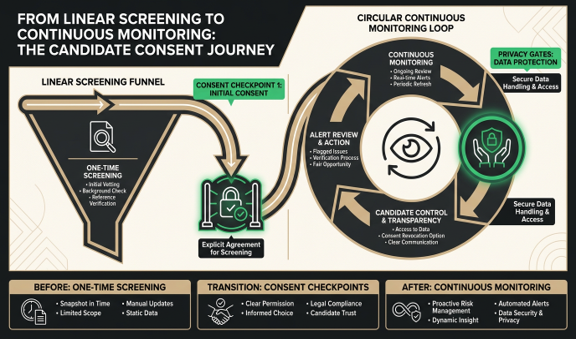
Privacy-First by Design: What Best Practice Looks Like in 2026
New state privacy laws and updated EEOC guidance are reshaping how we handle candidate data, while candidates increasingly expect transparency and control. The best practices for privacy-first employment background screening in 2026 center on three principles:
- minimize what you collect,
- maximize what candidates control, and
- document everything for compliance audits.
Store outcomes, not raw data. Keep personally identifiable information out of your HRIS entirely. Access verified results through secure portals while candidate PII stays in blockchain-encrypted vaults that you never touch or manage.
- Let candidates preview before sharing. Let candidates review their background report, address inaccuracies, or withdraw from consideration before any employer sees their data. First-party sharing through TruaScore® reduces FCRA disputes and builds trust.
- Standardize adverse action workflows. Document decision criteria, log consent events, and create audit trails that satisfy EEOC guidance on bias prevention. Configurable transparency means consistent, defensible hiring decisions.
- Apply data minimization by default. Follow NIST privacy principles by collecting only what you need for the specific role. Share scores or verification status rather than detailed records that expose more than necessary.
- Build consent into every step. Track when candidates agree to share, what they share, and with whom. This creates the paper trail you need for compliance while giving candidates meaningful control over their privacy choices through configurable verification workflows.
Reusable Digital Credentials: Faster Hiring, Fairer Outcomes
The shift toward reusable credentials transforms how we think about speed and fairness in hiring. When candidates control a portable TruaScore® (0–360), they can share verified results within 24 – 48 hours while you apply the same objective methodology to everyone. This approach eliminates the bias that creeps in when some candidates wait weeks while others get expedited processing. Portable credentials also reduce candidate drop-off because people see transparency and control, not surveillance.
Beyond speed improvements, the real advantage lies in getting the right signal without unnecessary data exposure. Instead of raw criminal records or credit reports, you receive a continuously updated TruaScore® built from over 410 million computation states. When public records change, TruaScore® reflects those updates within 48 hours. TruaBroker™ makes deployment seamless with zero integration requirements, so you can pilot this approach across high-volume roles immediately. Start small, measure your time-to-hire reduction, then scale based on results.