
By Marc Solomon

Every employer says they want faster hiring, lower risk, and stronger compliance. Every candidate wants a fairer process, more privacy, and fewer repetitive submission of personal data such as SSN, DoB, etc. . The current legacy background screening industry is still stuck in the Industrial age and has not kept pace with the rapid rise of Gig workers and AI deepfakes and threats.
It was built for a different era: one-time checks, fragmented systems, duplicated data collection, and delayed onboarding. In today’s environment, that model creates friction for honest candidates, unnecessary exposure for employers, and too many blind spots for teams responsible for trust and safety. Employers wait weeks to onboard a candidate losing productivity and potential economic activity.
That is why the next chapter of hiring and identity verification will not be defined by more point solutions. It will be defined by reusable Trust Credential that are portable across platforms and employers.
On a recent podcast conversation with Jim Beach on School for Startups Radio , I described this shift in simple terms: think of it as bringing the convenience and repeatability of a TSA Precheck model into the commercial world. Instead of asking people to repeatedly submit the same sensitive information to every employer, platform, or service, the future is a trust credential for life a person obtains along with a trust token number.
That change is bigger than convenience. It is a new trust architecture.
The old model is creating new risk
Traditional background checks are still largely built around one-time, employer-initiated screening. That means each employer or platform often collects personally identifiable information, stores it in another system, and repeats a process the candidate may have already completed elsewhere.
- For HR teams, that slows onboarding and adds administrative burden.
- For compliance teams, it introduces legal and procedural complexity.
- For gig and platform businesses, it creates friction at the exact moment they need to activate trusted workers quickly.
- For candidates, it often means less visibility, less control, and more chances for errors to affect outcomes before they can respond.
In a digital economy shaped by AI, fraud, and rising expectations around privacy, that model no longer scales well. If every new hiring workflow creates another copy of sensitive data, every new workflow also creates another point of exposure. That is the wrong direction.
Reusable trust credentials change the equation
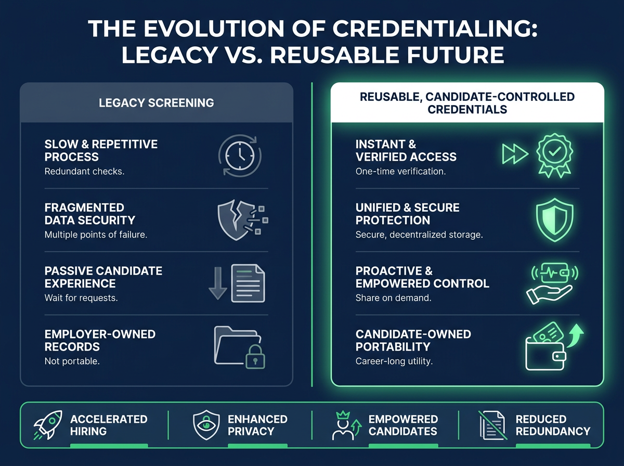
A reusable trust credential managed and shared by the individual flips the process from repeated data collection to verified, shareable proof.
Instead of forcing employers to gather and hold raw candidate PII data they do not need, a privacy-first candidate-controlled model allows the individual to complete verification directly, review their information, and share the verified result with the organization. The employer gets what matters for decision-making. The candidate keeps control over what is their PII in a blockchain, encrypted vault. Only they can access and share their verified trust credential as desired. Sensitive data exposure is drastically minimized from the start.
Rather than treating identity verification and screening as disconnected steps, Trua offers a unified path from identity verification to reusable trust credentials and continuous monitoring. That matters because trust is not static. A one-time check gives you a snapshot. A continuous model gives you visibility over time.
For enterprise teams, that distinction is critical. Risk does not pause after onboarding. Compliance obligations do not end once an offer is accepted. And reputational exposure does not wait for the next annual review cycle.
Candidate control is not a compromise. It is a competitive advantage.
Some organizations still assume that giving candidates more transparency or control weakens the rigor of the process. In reality, it significantly strengthens it.
When individuals can review their background report before sharing it, they have a chance to identify inaccuracies, resolve issues early, and participate in a process that directly affects their livelihood. That supports a more equitable experience while reducing downstream compliance and Fair Credit Reporting Act (FCRA) disputes, litigation, delays, and wrongful claims.
This is one of the most important differences in Trua’s model. Screening is not just continuous. It is also first-party and candidate-driven, helping support FCRA compliance while giving individuals a more active role in the process. Candidate’s personally identifiable information is stored within Trua’s blockchain-encrypted database, not the employer’s HR system, which helps reduce unnecessary data exposure. And because candidates can review their information before sharing it, employers gain a cleaner, more transparent workflow. These are not side benefits. They are structural building blocks in this new Trust Verification Infrastructure.
HR leaders now have a faster path from having a qualified candidate to a confident hire, Compliance leaders have a model designed to reduce risk, not just document it, and Platform’s trust and safety teams have a means for a smoother way to verify users and workers without repeatedly recreating the same friction.
The future of trust is portable
The long-term opportunity here is larger than hiring alone.
As more people move between jobs, contracts, platforms, and marketplaces, trust will need to move with them. Reusable trust credentials can help eliminate repetitive screening, reduce onboarding delays, and create a more efficient system for both organizations and individuals.
That is especially relevant in the gig economy and service platforms, where workers often need to prove trustworthiness across multiple environments. A portable credential model can help qualified people get to work faster while helping businesses maintain strong assurance standards.
Trust is not a one-time event. Continuous evaluation and continuous compliance monitoring give organizations a more durable way to manage workforce and regulatory risk over time.
A better model is already here.
The market does not need another patch for an outdated screening process. It needs a better Trust Infrastructure.
Reusable trust credentials offer a path to faster onboarding, stronger privacy, less unnecessary data exposure, and more durable compliance. They align with what modern organizations need and what modern candidates expect. They also reflect a simple truth: trust works better when it is verified once, shared with permission, and monitored intelligently over time.
That is the future we should be building toward now.
If your organization is rethinking hiring, identity verification, or ongoing workforce risk, this is the moment to move beyond one-time checks and legacy systems and processes. Explore how Trua and its solutions can help your organization build enduring trust with privacy-first, reusable, and continuous verification.