

Key Takeaways:
- Continuous, privacy-first screening platforms let you manage risk in real time. They also cut hiring delays that come with old-school, one-and-done background checks.
- Reusable digital trust credentials put candidates in control of their own data. That means better compliance, lower costs, and less unnecessary exposure of sensitive information.
- AI-driven analytics need to be transparent and bias-aware to support fair hiring. Look for vendors backed by independent audits and explainable outcomes.
Let’s be honest: background checks have been a bottleneck for years. About 70% of employers say they slow down hiring. And it gets worse. EEOC guidance shows that outdated screening practices put organizations at serious compliance risk. Think about it: you run a background check on day one, and then what? Nothing. New incidents can pop up at any point between hire and termination, and you will never know. That leaves HR teams constantly reacting to problems instead of getting ahead of them.
So, what is the best background check service for employers? It is not the one with the flashiest dashboard. It is the one that monitors risk continuously, without dumping sensitive data into your own systems. The best services combine FCRA compliance with candidate transparency. They blend AI-driven insights with bias mitigation. And they scale across the enterprise with zero IT integration requirements. The answer lies in next-generation screening platforms that rethink the whole process.
Some organizations are not waiting around. They have already moved to privacy-first models where candidates control their own verified credentials and share results directly with employers.
Trua’s continuous evaluation approach is a great example of this next-generation thinking. It delivers real-time risk visibility while keeping personally identifiable information secure. Ready to see how continuous screening can transform your hiring?
How To Choose the Best Background Check Service for Employers
Picking the right background screening partner goes beyond price and speed. You need to look at compliance rigor, integration complexity, and long-term operational efficiency. The goal is to find a solution that scales with your hiring needs while protecting both candidates and your organization.
What integration requirements should you expect from modern screening platforms?
The best platforms offer plug-and-play deployment that eliminates IT overhead. Look for solutions that connect through secure portals instead of requiring complex API development or system modifications. This can cut implementation time from months to days, and your team still gets the configurability it needs.
What data security certifications should be non-negotiable when evaluating vendors?
Two certifications should be non-negotiable: SOC 2 Type II and ISO 27001. These prove that a vendor undergoes regular third-party audits of its security controls, data handling procedures, and privacy safeguards. Without them, you are exposing your organization to unnecessary data breach risk.
What FCRA compliance standards must vendors demonstrate?
Make sure vendors can show evidence of Fair Credit Reporting Act compliance. That includes proper adverse action workflows, disclosure procedures, and dispute resolution processes. Also, confirm they understand recent CFPB guidance on algorithmic scoring. Falling behind on this can lead to regulatory violations and potential liability.
How important are turnaround times and continuous monitoring capabilities?
If you are still waiting 3 to 5 days for results, you are falling behind. The best background check service for employers delivers initial screening results within 24 to 48 hours. Even more important: evaluate vendors offering continuous monitoring that sends real-time alerts when new records appear. That beats paying for costly re-runs every time you need an update.
How do you calculate the true total cost of ownership beyond list prices?
Do not just look at the sticker price. Factor in costs for re-runs, rechecks, and the operational drag of managing point-in-time checks across your workforce. Traditional models require a brand-new screening for every internal transfer, promotion, or contractor conversion. Solutions offering reusable credentials like TruaScore® eliminate duplicate checks. That reduces long-term costs while speeding up internal mobility and rehiring.
What role do reusable digital trust credentials play in vendor selection?
Reusable credentials let candidates share verified background information across multiple roles, subsidiaries, and hiring cycles. No need to repeat the entire screening process each time. This can reduce time-to-hire by up to 70% for repeat applicants, and it gives candidates control over their own data. When evaluating vendors, ask how they handle credential portability and candidate transparency.
Continuous and Privacy-First Background Checks: What HR Needs to Know
Traditional background checks give you a snapshot at hire. Within days, that snapshot is already outdated. Modern HR leaders need to understand continuous monitoring models that protect candidate privacy while delivering ongoing risk visibility. Here are the key differences that matter for your hiring strategy and compliance posture.
How do first-party, candidate-driven flows maintain FCRA compliance?
Here is the key shift: when candidates run their own screening and choose what to share, employers avoid becoming users of consumer reporting agencies under the Fair Credit Reporting Act. That eliminates the complex disclosure, authorization, and adverse action procedures that come with traditional third-party relationships. Portable credentials reduce litigation risk by putting transparency and consent directly in the candidate’s hands.
Beyond compliance, the first-party model delivers a meaningful operational advantage that third-party providers simply cannot match. Because candidates own and control their own verified data, employers can initiate the background check process much earlier in the hiring journey, as early as the third interview, rather than waiting until after an offer is extended. With a traditional third-party provider, results often take days or weeks to come back after an offer, leaving employers in a holding pattern and at risk of losing a candidate to a competing offer. With a first-party model, by the time a candidate reaches the offer stage the screening is already complete and the only remaining step is drug testing. This not only accelerates time to hire significantly, it also allows organizations to build a bench of pre-screened candidates ready to deploy when the right role opens up, turning the background check from a bottleneck into a competitive advantage.
How does continuous background screening differ from traditional one-time checks?
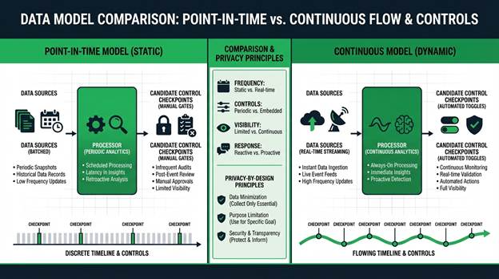
Continuous background screening monitors public records in real time. You get automated updates within 48 hours of new criminal, civil, or public record changes. Unlike point-in-time snapshots, this approach works especially well for roles involving financial responsibility, customer data access, or ongoing federal trust standards.
Who stores candidate PII, and how do blockchain-protected models prevent data exposure?
With privacy-first background checks, all personally identifiable information lives in blockchain-encrypted databases controlled by the screening provider. Employers never store it. Candidates share only verified results or trust scores, not the underlying records. This prevents unnecessary data exposure while still giving organizations the risk insights they need. TruaScore® is a great example of this. Employers get access to verified outcomes without ever storing sensitive employee data themselves.
What triggers continuous monitoring updates, and how quickly are changes reflected?
These monitoring systems scan over 25,000 public data sources. They look for new criminal records, civil judgments, professional license changes, and other relevant updates. Advanced platforms like Trua-CE reflect score changes within 24 to 48 hours of a new record appearing. That speed helps organizations catch emerging risks before they affect workplace safety or compliance. It is particularly valuable for roles with ongoing access to sensitive information.
How do reusable credentials reduce duplicate screening across business units?
Reusable trust credentials eliminate redundant background checks. Whether employees transfer between subsidiaries, work with staffing partners, or reapply for positions, they do not need to repeat the whole screening process. Instead, candidates share existing verified scores that reflect their current risk profile. This cuts costs, speeds up internal mobility, and improves the candidate experience. And you still maintain consistent risk visibility across every hiring decision.
AI-Driven Screening and Reducing Bias in Background Checks
AI promises to remove human bias from hiring decisions. But many HR leaders worry it might just create new forms of discrimination instead. Candidates are already frustrated with opaque screening processes that offer no explanation or recourse. If you are evaluating AI-driven background screening solutions, you need concrete ways to tell whether they actually reduce bias or just amplify existing inequities.
How can AI summarize complex records without introducing bias?
Responsible AI sticks to objective factors: conviction severity, recency, and legal relevance. It avoids subjective interpretations. Demand systems that exclude protected characteristics, arrest-only data where prohibited, and demographic proxies. Look for standardized scoring criteria that include severity weighting, time-based decay factors, and jurisdiction-specific legal standards applied the same way across every candidate.
What independent audits should vendors provide to prove fairness?
Ask for comprehensive bias testing across protected groups, differential impact analyses, and third-party validation studies updated annually. The EEOC expects vendors to show ongoing monitoring for discriminatory outcomes. Reputable providers should offer audit trails, model documentation, and compliance with NIST AI Risk Management standards. Promises of fairness are not enough.
How do you evaluate AI explainability for EEOC compliance?
Go with systems that show their reasoning for each decision. You should be able to see which factors influenced the outcome and how heavily they were weighted. Candidates deserve to know why they received a specific score, and they need a clear path to dispute inaccuracies. Make sure there is a human-in-the-loop review option, so your team can override algorithmic decisions when context matters. That is what the EEOC expects.
What prevents AI-driven background screening solutions from legal overreach?
The best systems have built-in compliance guardrails. They automatically respect ban-the-box laws, salary history restrictions, and state-specific reporting limits. They should exclude prohibited data sources without manual configuration and keep audit logs of every compliance decision. FTC guidance makes it clear: companies remain liable for discriminatory outcomes. That makes vendor compliance controls non-negotiable.
How does candidate transparency reduce disparate impact?
First-party verification models let candidates review their own reports before sharing them with employers. They can address errors or provide context that prevents unfair rejections. This gives people with complex histories a fair chance to explain their circumstances instead of getting hit with surprise disqualifications. TruaScore® puts this idea into practice. Candidates control when and how they share their verified trust credentials. The result: less bias and a better experience for everyone.
The 2026 Bottom Line: Speed, Privacy, and Continuous Trust Win
So, what is the best background check service for employers? It is one that combines continuous monitoring with privacy-first design and objective, bias-aware decisions at enterprise scale. The days of one-time snapshots that leave you blind to evolving workforce risk are over. Modern solutions deliver real-time visibility while protecting candidate privacy and reducing biased outcomes.
When you evaluate vendors, prioritize first-party models where candidates control their data sharing. Make sure personally identifiable information stays protected in blockchain-encrypted systems and that updates propagate within 48 hours. Look for reusable digital trust credentials, zero-integration deployment, and transparent compliance evidence. As industry analysts recognize, solutions like TruaScore® represent the future of fair, privacy-safe hiring.
Ready to speed up your hiring while keeping continuous risk visibility? Explore TruaScore® to see how reusable trust credentials can transform your talent acquisition process.