

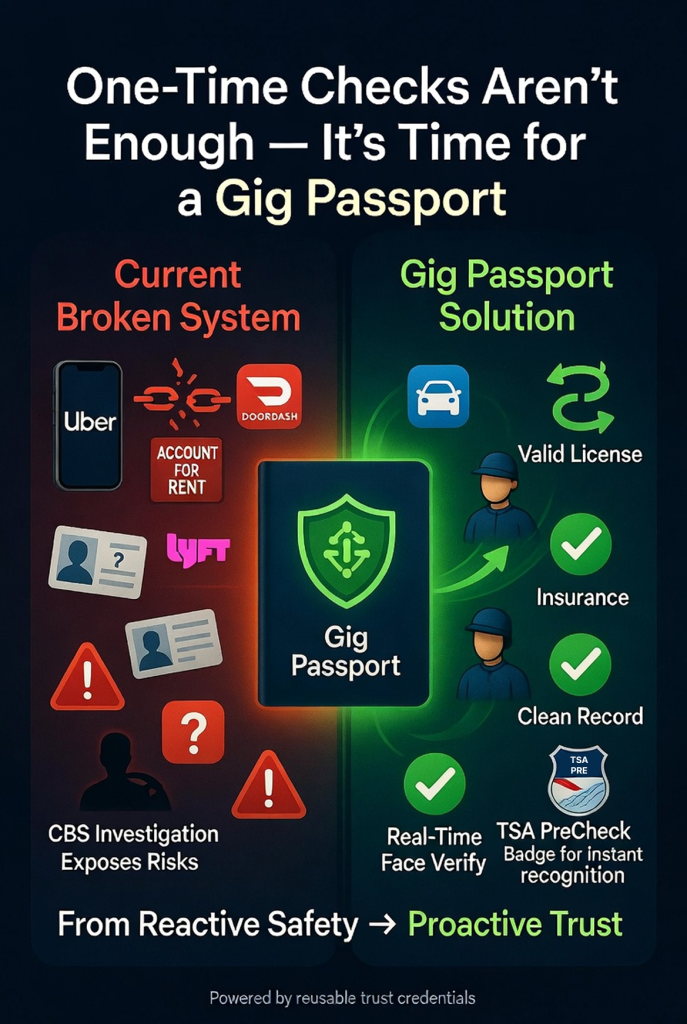
A recent CBS News Los Angeles investigation revealed a troubling reality in the gig marketplace: delivery and rideshare accounts are being bought, rented, and used by individuals who were never properly vetted. In some cases, drivers may not even hold a valid driver’s license.
The story raises serious concerns about identity verification, customer and general public safety, as well as platform accountability for the growing gig economy and its workforce. This eerily reminds me of the North Korean IT worker scheme (also called DPRK fake worker or remote IT infiltration) – a well-documented national security and fraud risk that surged in visibility in 2025 – 2026. North Korean operatives (often working for the regime) use stolen or synthetic U.S. identities, fake LinkedIn profiles, AI-generated resumes/photos/voices, and U.S. facilitators to secure remote tech, development, and IT jobs at American companies
This issue is not just about bad actors slipping through the cracks. It exposes a deeper structural flaw in how digital platforms handle trust – trust with their workers, customers, shareholders, and even the community at large. Unfortunately, for many digital platforms, trust and safety is an afterthought and they sometimes tend to just do the minimum so they can check the box.
Today’s gig marketplace platforms have not solved for moving service provider’s trust across those systems. Each platform operates as its own isolated environment, forcing workers to repeatedly verify their identity, upload documents, and undergo often one and done background check, across different digital gig/ work opportunity. Unfortunately, these fragmented systems were built this way and have operated like this for decades with major security, trust, and safety gaps, and the rapid proliferation of AI and deepfakes is now pushing them out of control.
The Two-Part Problem
This fragmented model creates two problems at once.
- First, it slows down legitimate workers who are ready to earn but are stuck waiting through redundant onboarding processes.
- Second, it creates vulnerabilities that bad actors can exploit, such as account sharing and identity fraud, exactly the kind highlighted in the CBS investigation.
A driver may pass a background check on day one, but what happens next? The driver’s license expires. Insurance lapses. New driving violations occur. Accounts get shared or sold. When these gig marketplace platforms rely on one-time verification tied to merely a user/password based account, they are relying on a snapshot-in-time rather than a living, continuously validated identity.
The Gig Passport Approach
What gig platforms really need is not more isolated IDV and one-time-only background screening queues, but a portable, reusable, and continuously updated trust credential – a “gig passport.” It is important to bind an identity token (or a trust credential) to an individual and not to any one device or a faceless user/password account to avoid sharing of devices or accounts.
A gig passport would allow a worker’s verified identity, continuously screened background status, driver’s license, and qualifications to travel with them across one platform to another … from Uber to Lyft, DoorDash to Grubhub. Instead of redoing the same checks repeatedly, gig workers could present a trusted, continuously updated credential issued and maintained by a neutral verification provider. This not only provides high assurance of gig platform participants, but also provides significant efficiencies, cost savings and higher level of trust and safety of their platforms.
Think of it like TSA PreCheck for the gig economy. Once verified, you move faster between airports and ailines, but security is still maintained, and in many ways, strengthened.
This approach addresses both sides of the problem highlighted by this investigation:
- It reduces fraud by ensuring the person using the account is continuously verified as the same individual who was screened. [When the driver starts their shift by logging in, they also verify themselves and their location in real-time, in seconds.]
- It improves safety through ongoing monitoring rather than one-time checks.
- It eliminates redundant onboarding delays for legitimate workers.
- It reduces the amount of sensitive personal data each platform must store, lowering breach and liability risks.
From Reactive to Proactive Safety
A stronger model combines:
- Verified digital identity tied to the individual, not just the account
- Continuous background and credential monitoring
- Real-time validation that the person using the account is the approved gig worker
- Portable credentials that reduce duplication while increasing consistency
Platforms don’t have to build this from scratch. Solutions like Trua’s reusable trust credential and continuous screening platform already enable this type of gig passport model.
By enabling verified identity, continuous monitoring, and reusable trust credentials, these gig marketplace platforms can more confidently confirm that the person behind the account, and the wheel, is the person who was hired and screened.
In an environment where account sharing and impersonation are real risks, reusable identity is not just a convenience, it’s an added layer of protection for customers, workers, the platform, and even the general public driving on or walking down the same roads.
In a labor market defined by flexibility and immediacy, trust should not reset every time a worker switches apps. It should travel with them.
What is a gig passport, and why does it matter?
A gig passport is a portable, reusable trust credential that allows gig workers to carry verified identity, background status, and qualifications across platforms. It matters because it reduces fraud, speeds up onboarding, and eliminates repetitive verification processes while improving overall safety.
How would continuous verification improve marketplace platform safety, like Uber, DoorDash, TaskRabbit, etc.?
Continuous verification ensures that gig workers (drivers, technicians) remain qualified over time by monitoring changes such as license status, insurance validity, or new violations. It replaces one-time background checks with an ongoing system that reflects real-world conditions, reducing risks like account sharing or expired credentials.
How can marketplace platforms balance speed and security without adding friction?
By using reusable identity credentials like Trua, platforms can instantly verify gig workers using pre-validated credentials while maintaining continuous monitoring in the background. This allows faster onboarding without sacrificing safety or increasing operational burden.
Sources:
May 12, 2026: CBS News Los Angeles: https://www.cbsnews.com/news/uber-doordash-lyft-rented-stolen-accounts-fraud-rideshare-food-delivery/
May 12, 2026: CBS News California: https://www.cbsnews.com/losangeles/video/uber-doordash-and-lyft-accounts-are-being-rented-and-stolen-online-investigation-finds/